Yes. In England and Wales an electronic signature can legally sign a document, including most contracts, provided the person signing intends to authenticate it and any formalities for that type of document are met. That is how the Law Commission summarised the law in its 2019 report, and the government agreed. Some documents carry extra formalities, such as deeds that must be signed in front of a witness, wills and lasting powers of attorney, so a quick e-signature is not always enough.
This guide is general information about the law of England and Wales at the time of writing (October 2026), not legal advice. If the document is governed by Scottish or Northern Irish law, check the rules there, and for anything high-value or unusual, speak to a solicitor before you sign.
What counts as an electronic signature?
UK law defines an electronic signature broadly. UK eIDAS describes it as data in electronic form that is attached to or logically associated with other electronic data and is used by the signatory to sign. In everyday terms, all of these can be electronic signatures:
- your name typed at the end of an email;
- clicking an "I accept" box on a website;
- a signature drawn with your finger or a mouse;
- an image of your handwritten signature placed in a PDF;
- a signature made through an e-signing platform, with or without a digital certificate.
The Law Commission gives the first two as examples. What turns any of these into a signature is the intention behind it: you meant it to show that you agree to, or are authenticating, the document.
The law in three parts
The Electronic Communications Act 2000
Section 7 of the Electronic Communications Act 2000 says that, in legal proceedings, an electronic signature linked to an electronic communication or data is admissible in evidence about whether that communication or data is authentic and has not been altered. How much weight a court gives it depends on the circumstances.
UK eIDAS
UK eIDAS is the EU regulation on electronic identification and trust services as it continues in UK law, with amendments made for Brexit. Article 25 says an electronic signature must not be denied legal effect, or refused as evidence, just because it is electronic or does not meet the requirements for a qualified signature. It also says a qualified electronic signature has the same legal effect as a handwritten one.
UK eIDAS recognises three levels:
| Level | What it means | Typical example |
|---|---|---|
| Simple | Any electronic signature; not defined or regulated by UK eIDAS | A typed name, a drawn signature, a click to accept |
| Advanced | Uniquely linked to and capable of identifying the signer, under their sole control, and linked to the data so any later change is detectable | Certificate-based signing through a specialist platform |
| Qualified | An advanced signature made with a qualified signature creation device and based on a qualified certificate | Signatures from a qualified trust service provider |
The government's 2025 call for views on trust services gives typing your name in a document or email as an example of a simple e-signature. It also notes that, unlike in some European countries, neither advanced nor qualified e-signatures are widely used in the UK. For most small-business paperwork, a simple e-signature is what both sides use.
The Law Commission's 2019 report
The Law Commission reviews the law of England and Wales. Its September 2019 report on the electronic execution of documents set out a statement of the law: an electronic signature is capable in law of being used to execute a document, including a deed, provided that the person signing intends to authenticate the document and any formalities relating to its execution are satisfied. The government responded in March 2020, confirming that it agreed with these conclusions.
The report did not cover wills, or registered dispositions under the Land Registration Act 2002. Those have their own rules, covered below.
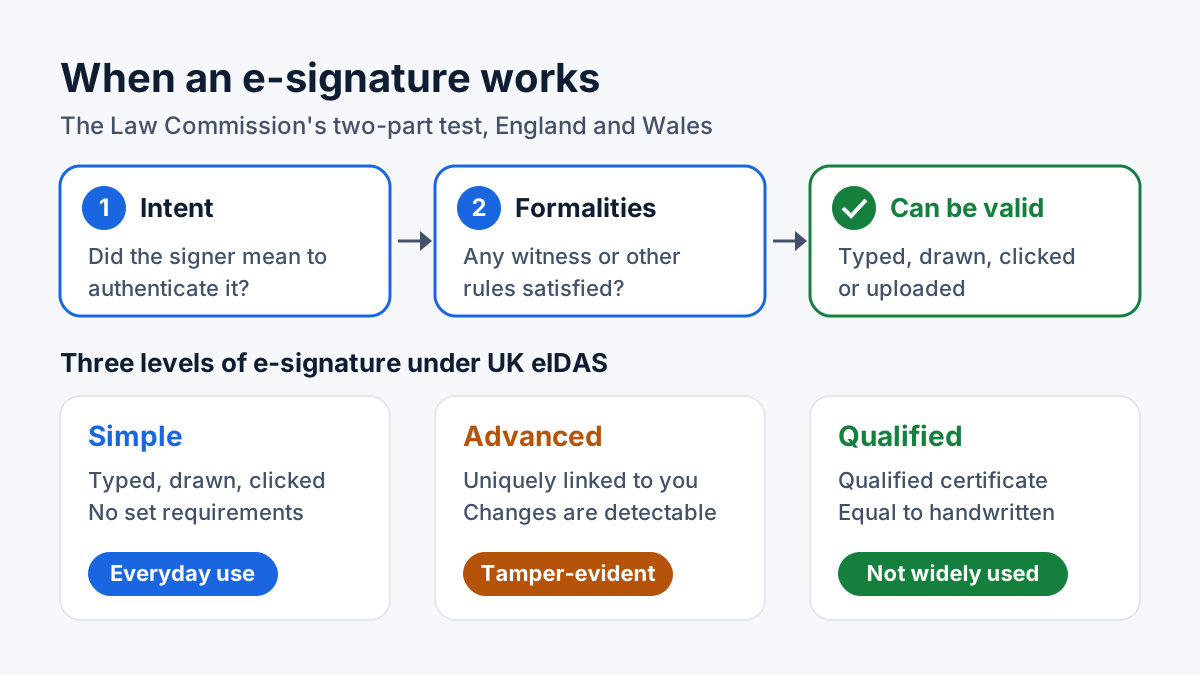
Intent plus any formalities: the two questions that decide whether an e-signature works.
Documents that need more than a quick e-signature
"Formalities" are where most of the risk sits. These are the main examples a small business is likely to meet.
| Document | What the rules say | What it means in practice |
|---|---|---|
| Deeds signed by an individual | Must be signed in the presence of a witness who attests the signature, and delivered as a deed (Law of Property (Miscellaneous Provisions) Act 1989, section 1) | The Law Commission's view is that the witness must be physically present, even if both of you sign electronically |
| Documents signed by a company | Validly executed if signed by two authorised signatories, or by one director in the presence of a witness who attests the signature (Companies Act 2006, section 44) | A director signing alone needs a witness; check your own articles and any instructions from the other side |
| Wills | GOV.UK says you must sign in the presence of two witnesses over 18, who sign in your presence | Sign by hand in front of your witnesses, following GOV.UK's or a solicitor's instructions |
| Lasting powers of attorney | GOV.UK says everyone must sign the same original document and cannot sign copies or use digital signatures | Print the forms and sign them by hand |
| Property transfers and mortgages for HM Land Registry | HM Land Registry's Practice Guide 82 sets out which electronic signatures it accepts, and simple e-signatures are not accepted for most deeds such as transfers and legal charges | Your conveyancer will use an accepted process, such as a signing platform they control, with the witness physically present |
On wills, GOV.UK's guidance on video-conferencing explains that temporary rules allowing video witnessing covered wills made up to 31 January 2024, and even those rules did not allow electronic signatures. For lasting powers of attorney, the GOV.UK guide to making an LPA sets out who signs and who can be a witness.
The other party can add formalities too. A lender, landlord or large customer may specify how a document must be signed, such as through their own platform, and if you have agreed to that, follow it.
How to make an e-signature easier to rely on
The law accepts e-signatures, but in a dispute someone may still need to show who signed, what they signed and when. These habits help.
- Agree the method. A line in your email, such as "please sign and return electronically", avoids arguments later.
- Sign the final version only, and make sure every page is the one that was agreed.
- Make identity clear. Use business email addresses, and for higher-value deals consider a signing platform that records an audit trail or verifies identity.
- Show the capacity you sign in, for example "Director, for and on behalf of" your company. If you are setting one up, our guide to setting up a limited company in the UK covers the basics of directors' roles.
- Keep the evidence: the signed PDF, the covering emails and any platform certificate.
- Check for formalities first. If the document is described as a deed, involves land, or is a will or LPA, stop and check the rules above.
Where free PDF tools fit
For everyday documents with no special formalities, signing a PDF yourself is quick. Desirly's free Sign PDF tool lets you draw, type or upload your signature and add initials, the date and text. It creates a visual electronic signature, which is an image in the PDF. It is not a certificate-based advanced or qualified signature, and it does not send documents to others for signing or keep an audit trail, so it suits signing your own copy of a quote, order form or supplier agreement. If a form needs completing first, the PDF forms tool fills in existing fields and can flatten them so the answers are fixed before you sign.
For a step-by-step walkthrough, see how to sign a PDF online for free. For deeds, property, wills and LPAs, use the process the rules require, and take advice from a solicitor if you are unsure.
For everyday paperwork with no special formalities, the free Sign PDF tool is the quickest place to start.
Frequently asked questions
Is an email with my typed name legally binding?
It can be. The Law Commission lists a name typed at the bottom of an email as an example of an electronic signature. Whether a binding contract exists also depends on the ordinary rules of contract, such as whether there was a clear offer and acceptance.
Can someone witness my signature over a video call?
For deeds, the Law Commission's view is that the witness must be physically present. The temporary video-witnessing rules for wills covered wills made up to 31 January 2024 and did not allow electronic signatures.
Is a qualified electronic signature the same as a handwritten one?
UK eIDAS says a qualified electronic signature has the equivalent legal effect of a handwritten signature. Most UK businesses do not need one for everyday contracts.
Did Brexit change the rules?
EU eIDAS continues in UK law in amended form, known as UK eIDAS, so the same three levels of e-signature apply, alongside the Electronic Communications Act 2000.
Sources
- Electronic Communications Act 2000, section 7 (legislation.gov.uk)
- UK eIDAS Article 25: legal effects of electronic signatures (legislation.gov.uk)
- Law Commission: Electronic execution of documents (2019 report)
- Law of Property (Miscellaneous Provisions) Act 1989, section 1 (legislation.gov.uk)
- HM Land Registry Practice Guide 82: electronic signatures accepted by HM Land Registry (GOV.UK)
This guide is general information, not legal, tax or financial advice. Fees, rules and thresholds change, so check the official source before you act. Spotted something out of date? Tell us and we will review it.